
Will AI replace simultaneous interpreters?

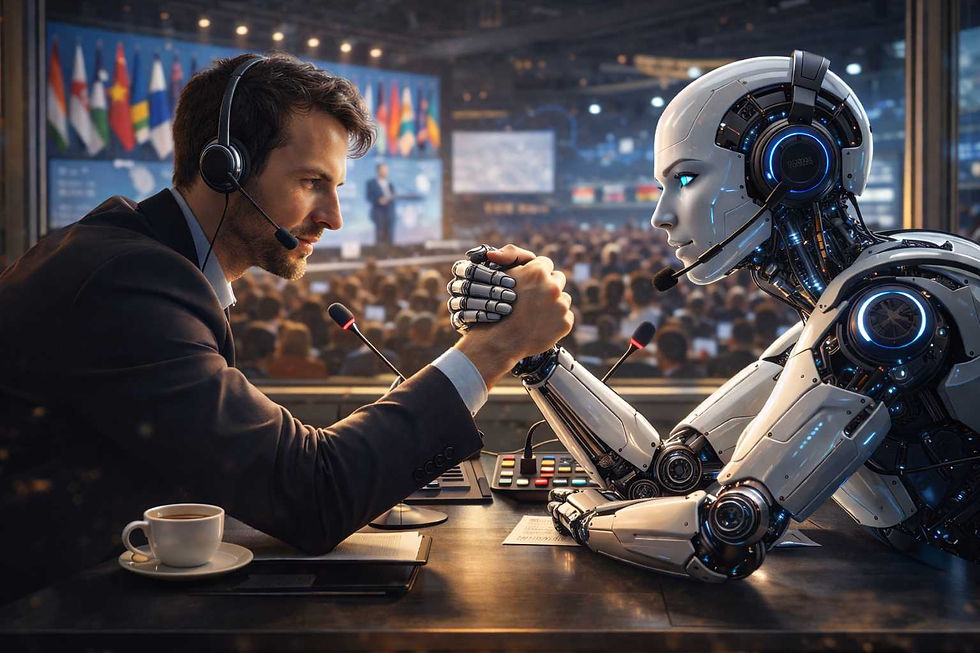
Will AI replace conference interpreters?
Short answer: no.
Long answer: not in the environments where accuracy, trust, and human judgment actually matter.
AI translation tools have improved dramatically. They can summarize meetings, translate conversations and complicated texts. But interpreting at international conferences, government meetings, and high-level negotiations is a different discipline entirely. Here's why.
1️⃣ Meaning is more than words
Simultaneous interpreters don't translate vocabulary - they convey intent, tone, nuance, and diplomatic weight. When a minister says something cautiously, humorously, or strategically, the interpreter must reproduce the impact, not just the sentence.
2️⃣ Context is everything
Conference interpreters work across law, finance, energy, medicine, and geopolitics - often within the same event. Understanding context in real time allows interpreters to choose the correct terminology instantly. AI still struggles when terminology shifts mid-discussion or when speakers deviate from prepared remarks.
Anyone who has done any prompting using Claude, ChatGPT or any other AI tool, understands how important it is to provide context to the AI every time you give it an important task. And what task can be more important at an international gathering that to convey the message to people from a different cultural and linguistic background, in the form and with the meaning and intent of the original message?
For human interpreters this context window is decades of professional experience in various spheres, cultures, settings, personal contacts and intimate understanging of the intricacies of the human and political dialogue.
No AI tool currently has a context window long enough to embody the life of a professional interpreter.
3️⃣ Live events are unpredictable
Speakers interrupt each other. Microphones fail. Accents vary. Slides change. Jokes land. Human interpreters adapt instantly and keep communication flowing smoothly - something automation cannot reliably manage in dynamic live environments.
4️⃣ Trust and confidentiality matter
High-level meetings often involve sensitive discussions. Clients must trust that what is said remains confidential and faithfully rendered. Human professionals operate under strict ethical codes and professional accountability.
5️⃣ Communication is human.
Interpreting is not only technical - it is relational. Interpreters read the room, sense tension, soften phrasing when necessary, and preserve diplomatic balance. This human intelligence cannot be automated.
Where AI helps is by being a powerful support tool:
✔ terminology preparation
✔ transcript generation
✔ instant reference base
But in high-stakes multilingual communication, it remains an assistant - not a replacement.
The future isn't human vs. AI. It's human expertise supported by intelligent tools. And when the message truly matters, people still trust people to carry it across languages.
Comments